In the heart of the Namib Desert, where rainfall is a rarity and survival is a relentless challenge, one plant has evolved a breathtakingly efficient strategy to conserve water. The Welwitschia mirabilis, commonly known as the welwitschia or tree tumbo, stands as a testament to nature's ingenuity. This ancient gymnosperm, often called a "living fossil," can live for over a thousand years, enduring some of the harshest conditions on Earth. Central to its remarkable longevity is a unique circadian rhythm governing the opening and closing of its stomata—a biological innovation that has captivated botanists and ecologists alike.
The welwitschia's stomatal behavior defies conventional plant physiology. Unlike most plants, which open their stomata during the day to facilitate photosynthesis and close them at night to reduce water loss, the welwitschia exhibits a reversed pattern. Its stomata open predominantly at night, allowing the plant to take in carbon dioxide when temperatures are cooler and humidity is relatively higher. This nocturnal activity minimizes water loss through transpiration, a critical adaptation in an environment where every drop of water is precious. During the scorching daytime hours, the stomata remain tightly closed, sealing in moisture and shielding the plant from the dehydrating effects of the desert sun.
This reversed stomatal rhythm is governed by an intricate interplay of environmental cues and internal biological clocks. The plant's internal circadian system is finely tuned to the desert's extreme diurnal temperature fluctuations and low humidity. Phytochromes and cryptochromes—light-sensitive proteins—help synchronize the stomatal activity with the light-dark cycle, while hormonal signals, particularly abscisic acid (ABA), play a pivotal role in triggering stomatal closure during the day. The welwitschia's ability to maintain this rhythm even in constant laboratory conditions underscores the robustness of its endogenous clock, a trait honed by millennia of evolutionary pressure.
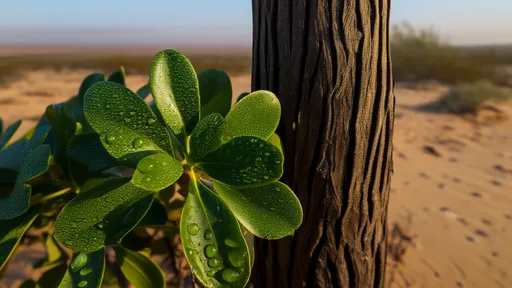
The anatomical features of the welwitschia's leaves further complement its stomatal strategy. Its two perennial leaves, which grow continuously throughout the plant's life, are thick, leathery, and covered with a dense layer of wax. This cuticular layer reduces non-stomatal water loss, while the sunken stomata create a microclimate that traps moisture near the leaf surface. Additionally, the plant's deep taproot system accesses groundwater, providing a steady, albeit minimal, supply of water to sustain its metabolic processes. Together, these adaptations form a cohesive system that maximizes water use efficiency.
From an ecological perspective, the welwitschia's stomatal behavior has profound implications for its survival and the broader desert ecosystem. By minimizing daytime transpiration, the plant reduces its water requirements, allowing it to thrive in areas where other vegetation cannot. This efficiency also enables the welwitschia to contribute to the desert's carbon cycle during the night, a time when most plants are inactive. Its ability to fix carbon dioxide nocturnally, similar to Crassulacean Acid Metabolism (CAM) plants but through a distinct mechanism, highlights the diversity of evolutionary pathways to arid adaptation.
Understanding the welwitschia's unique stomatal rhythm offers valuable insights for applied sciences, particularly agriculture and water resource management. As climate change exacerbates drought conditions in many regions, crops with improved water-use efficiency are increasingly vital. Researchers are studying the genetic and physiological mechanisms behind the welwitschia's adaptations, with the hope of engineering crops that can better withstand water scarcity. Moreover, this ancient plant serves as a model for biomimetic technologies, inspiring innovations in sustainable design and passive cooling systems that mimic its water-conserving traits.
In conclusion, the welwitschia's reversed stomatal rhythm is a marvel of evolutionary adaptation, enabling it to master the art of water conservation in one of the planet's most inhospitable environments. Its story is not just one of survival but of thriving against the odds, offering lessons in resilience and efficiency that resonate beyond the confines of the Namib Desert. As we face global challenges related to water security and climate change, the secrets held by this thousand-year-old plant may well hold the key to a more sustainable future.

By /Aug 27, 2025
By /Aug 27, 2025

By /Aug 27, 2025
By /Aug 27, 2025

By /Aug 27, 2025

By /Aug 27, 2025

By /Aug 27, 2025
By /Aug 27, 2025

By /Aug 27, 2025

By /Aug 27, 2025

By /Aug 27, 2025

By /Aug 27, 2025

By /Aug 27, 2025

By /Aug 27, 2025

By /Aug 27, 2025
By /Aug 27, 2025

By /Aug 27, 2025

By /Aug 27, 2025
By /Aug 27, 2025
By /Aug 27, 2025
