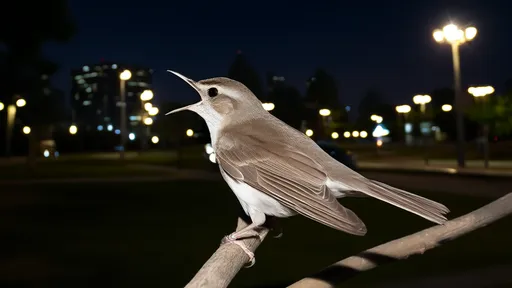
In the heart of bustling cities, where the cacophony of human activity often drowns out nature's whispers, a remarkable adaptation is taking place among urban nightingales. These birds, celebrated for their complex and melodious songs, are altering their vocal frequencies to be heard above the relentless hum of traffic and machinery. This phenomenon represents a fascinating intersection of animal behavior, urban ecology, and evolutionary biology, revealing how wildlife persists and even thrives in human-dominated landscapes.
Nightingales, particularly the Common Nightingale (Luscinia megarhynchos), have long been subjects of admiration for their powerful and varied songs, typically used to attract mates and defend territories. However, as urban sprawl encroaches on their habitats, these birds face an unprecedented challenge: anthropogenic noise pollution. Studies have shown that low-frequency noise from vehicles and industrial activities masks the lower pitches of bird songs, which are crucial for communication. In response, urban nightingales have been observed shifting their songs to higher frequencies, a behavioral plasticity that allows their messages to cut through the noise.
Research conducted across European cities, such as Berlin and Madrid, has documented this shift in detail. Using sophisticated audio recording equipment and spectral analysis, ornithologists have compared the songs of nightingales in noisy urban areas with those in quieter rural settings. The findings are consistent: urban birds sing at a higher minimum frequency, often by several hundred hertz, effectively avoiding the masking effect of low-frequency urban din. This adjustment is not merely a minor tweak but a significant modification that underscores the birds' ability to adapt rapidly to changing environments.
This vocal adaptation is a testament to the nightingale's cognitive flexibility. Unlike innate behaviors fixed by genetics, song learning in birds involves a period of vocal practice and social interaction, allowing for adjustments based on environmental feedback. Urban nightingales appear to be listening to their surroundings and modifying their songs in real-time, a process that may involve trial and error or social learning from other birds. This plasticity is crucial for their survival, as ineffective communication could lead to failed mating attempts or increased territorial conflicts.
However, this adaptation comes with potential trade-offs. Higher-frequency songs may travel shorter distances or be less effective in conveying certain information, such as the singer's size or health, which is often encoded in lower frequencies. Some studies suggest that female nightingales might prefer lower-pitched songs, associating them with more robust mates. Thus, urban males singing at higher pitches could face disadvantages in courtship, potentially impacting reproductive success. Yet, the persistence of nightingales in cities indicates that the benefits of being heard outweigh these costs, at least for now.
The implications of this acoustic adaptation extend beyond nightingales alone. It highlights a broader pattern of urban evolution, where species undergo rapid changes in morphology, behavior, and physiology in response to human-altered environments. For instance, some urban birds develop shorter, more rapid songs or sing during quieter times of the day, such as early morning or night. These changes are not just curiosities; they are critical for biodiversity conservation in an increasingly urbanized world. Understanding how species adapt can inform urban planning, such as designing noise barriers or creating green spaces that mitigate the impacts of noise pollution.
Moreover, the nightingale's story is a poignant reminder of the pervasive impact of human activities on wildlife. Noise pollution is often overlooked compared to other environmental threats like habitat destruction or chemical pollution, but it disrupts essential behaviors in animals, from communication to predation. The nightingale's ability to adapt offers a glimmer of hope, suggesting that some species can cope with these challenges. However, it also raises concerns about the limits of such adaptability. If noise levels continue to rise, even these resilient birds may reach a threshold beyond which further adjustment is impossible.
Conservation efforts are beginning to incorporate these insights. In some cities, initiatives to reduce nighttime noise or create "quiet zones" in parks are helping to preserve acoustic environments for wildlife. Public awareness campaigns are also emphasizing the importance of reducing unnecessary noise, not just for human well-being but for the creatures that share our urban spaces. The nightingale, with its beautiful and adaptable song, serves as an ambassador for these efforts, symbolizing the resilience of nature in the face of adversity.
In conclusion, the urban nightingale's shift to higher-frequency songs is a compelling example of behavioral adaptation in action. It reflects a dynamic interplay between animal behavior and environmental pressure, showcasing how nature innovates to survive. As cities grow louder, the songs of these birds remind us that even in the most artificial landscapes, evolution is still at work, tuning life to the frequencies of change. This ongoing symphony of adaptation invites us to listen more closely—not only to the nightingales but to the broader lessons they offer about coexistence in the Anthropocene.

By /Aug 27, 2025

By /Aug 27, 2025

By /Aug 27, 2025

By /Aug 27, 2025

By /Aug 27, 2025

By /Aug 27, 2025

By /Aug 27, 2025

By /Aug 27, 2025

By /Aug 27, 2025

By /Aug 27, 2025

By /Aug 27, 2025

By /Aug 27, 2025
By /Aug 27, 2025

By /Aug 27, 2025

By /Aug 27, 2025

By /Aug 27, 2025

By /Aug 27, 2025

By /Aug 27, 2025
By /Aug 27, 2025

By /Aug 27, 2025
