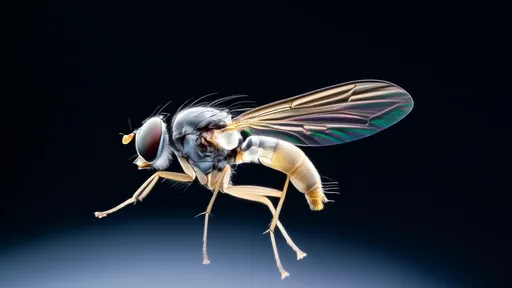
In the intricate world of insect flight, few subjects captivate researchers quite like the flight efficiency of Drosophila melanogaster, the common fruit fly. These tiny aviators perform aerial maneuvers with an agility that defies their size, executing rapid wing beats and precise directional changes that leave engineers in awe. At the heart of this remarkable capability lies a sophisticated biological mechanism: the elastic energy storage system within their flight muscles. This system not only powers their sustained flight but does so with an efficiency that has inspired biomimetic research across aerospace and robotics.
The flight muscles of Drosophila are classified as asynchronous or fibrillar muscles, a characteristic shared with many other insects capable of high-frequency wing beats. Unlike synchronous muscles, which contract once for each nerve impulse, asynchronous muscles contract multiple times per neural stimulus, enabling wing beat frequencies that can exceed 200 cycles per second. This is made possible by the muscle's inherent elasticity and its ability to store and release energy rhythmically. The key to this process lies in the proteins within the muscle fibers, particularly actin and myosin, which interact in a way that allows for oscillatory contractions without continuous neural input.
Central to the energy storage mechanism is the protein resilin, a highly elastic polymer found in the cuticle and associated structures of the flight system. Resilin boasts near-perfect elastic efficiency, with the ability to return approximately 97% of the stored energy upon release. In Drosophila, resilin is strategically located in the wing hinges and thorax, acting as a biological spring that stores kinetic energy during the deceleration phase of the wing stroke and releases it to assist in the subsequent acceleration. This reduces the metabolic cost of flight significantly, as the muscles do not need to generate all the required energy anew for each wing beat.
The thorax of the fruit fly, a rigid yet lightweight structure, serves as the central platform for this energy exchange. It functions like a resonant system, where the mechanical properties of the cuticle and the attached muscles are tuned to the natural frequency of the wing beats. During flight, the dorsal-ventral muscles and the longitudinal muscles work in antagonistic pairs. As one set contracts to depress the wings, it stretches the opposing set, storing energy in the elastic elements like resilin and in the stretched muscle filaments themselves. This stored energy is then utilized to power the wing's return stroke, creating a continuous cycle that minimizes energy waste.
This elegant system is not merely a passive spring; it is dynamically regulated by the nervous system. While the basic oscillatory rhythm is self-sustaining due to the muscle's mechanical properties, the nervous system modulates the amplitude and frequency of the contractions to control flight speed, direction, and stability. Sensory feedback from the wings and eyes adjusts muscle tension in real-time, ensuring that the energy storage and release are perfectly synchronized with the fly's intended maneuvers. This integration of passive elasticity and active neural control represents a pinnacle of evolutionary engineering.
The implications of understanding this mechanism extend far beyond entomology. Aerospace engineers study Drosophila flight to inform the design of micro-air vehicles (MAVs), which face similar challenges of size, weight, and power constraints. The principles of elastic energy storage are being incorporated into artificial muscle designs and resonant actuators, aiming to achieve the same efficiency and endurance seen in nature. Similarly, in robotics, these insights are driving the development of more agile and energy-efficient flying robots, capable of sustained operation without frequent recharging.
Despite significant advances, many questions remain. How exactly do the molecular components like titin and other elastic proteins contribute to energy storage? What are the precise mechanisms that allow such rapid energy cycling without fatigue? Ongoing research employs techniques like high-speed videography, computational modeling, and genetic manipulation to probe deeper into these questions. For instance, studies knocking out resilin genes have shown a measurable decrease in flight efficiency, confirming its critical role, but also hinting at redundant or compensatory mechanisms yet to be discovered.
In conclusion, the flight efficiency of Drosophila melanogaster, powered by its sophisticated elastic energy storage system, stands as a testament to the ingenuity of natural selection. This system, combining resilient materials, biomechanical tuning, and neural precision, allows the fruit fly to achieve feats of endurance and agility that are the envy of engineers. As research continues to unravel its complexities, the potential applications in technology and medicine seem boundless, promising a future where machines can fly with the grace and efficiency of a common insect.

By /Aug 27, 2025
By /Aug 27, 2025

By /Aug 27, 2025
By /Aug 27, 2025

By /Aug 27, 2025

By /Aug 27, 2025

By /Aug 27, 2025

By /Aug 27, 2025

By /Aug 27, 2025

By /Aug 27, 2025

By /Aug 27, 2025

By /Aug 27, 2025
By /Aug 27, 2025
By /Aug 27, 2025

By /Aug 27, 2025

By /Aug 27, 2025

By /Aug 27, 2025

By /Aug 27, 2025

By /Aug 27, 2025
By /Aug 27, 2025
